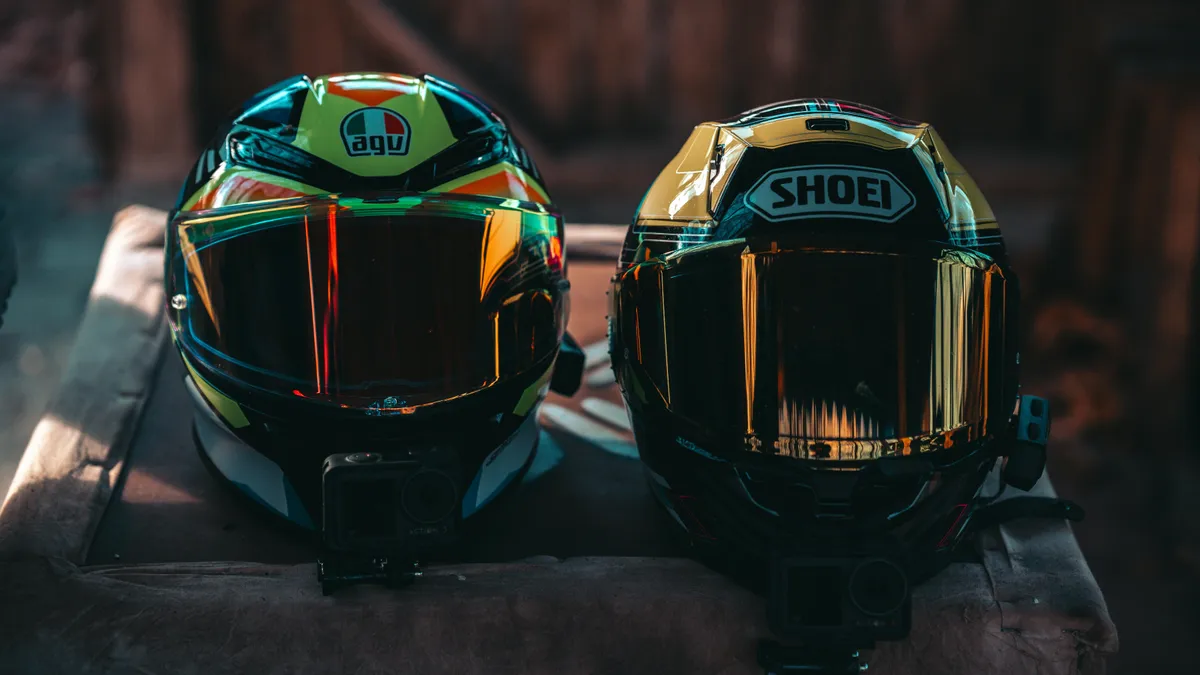
Best Motorcycle Helmets 2026
Top-rated motorcycle helmets for US riders. DOT and Snell certified with expert safety ratings. From budget to premium, find your perfect helmet.

Obsessive researcher who reads every Reddit thread and expert review so you don't have to. Years of research behind every guide.
Looking for more gear recommendations?
Browse All GuidesYour helmet is the one piece of gear that decides whether a bad day stays survivable. Everything else protects skin and bones. This protects the part of you that makes you you. Get it right and the rest of your kit is just detail. For most American riders the smartest buy in 2026 is the AGV K6 S: a carbon-aramid shell that weighs about as much as a can of soda, carries the strict ECE 22.06 rating, and fits a huge range of head shapes. But it is not the only answer, and if money is tight there is a $140 helmet below that I would put on my own head without a second thought.
I earn a small commission if you buy through links on this page, at no extra cost to you. As an Amazon Associate, we earn from qualifying purchases. I only point riders toward gear I would be happy to wear myself.
In a Rush? Buy the AGV K6 S. Light, quiet enough, ECE 22.06 certified, and it fits almost everyone. Spend less and the HJC i10 gives you Snell-rated safety. Spend more and the Shoei RF-1400 is the quietest, best-finished lid most of us will ever own.
| Best For | Product | Why This One |
|---|---|---|
| Overall | AGV K6 S | Carbon-aramid shell, ECE 22.06, light, fits most heads |
| Budget | HJC i10 | DOT and Snell M2020 for the price of a tank of gas, twice |
| Premium | Shoei RF-1400 | Quietest, best-built full-face in its class |
How I Picked These: I spent years on bikes and a lot of hours reading crash data, owner threads on r/motorcycles, and the testing notes that sites like RevZilla and webBikeWorld publish. I have not crash-tested any of these myself, and nobody honest has, because you only get to test a helmet that way once. So this list leans on certification bodies that do destructive testing for a living, on the standards each helmet actually carries, and on what thousands of owners report after living with these lids through real seasons. Prices are approximate and checked May 2026. Check the current price on Amazon before you buy, because helmet pricing moves around constantly.
Full-Face, Modular, or Open-Face? Before the picks, settle on a style, because it changes everything about protection. A full-face helmet has a fixed chin bar, and that matters more than new riders expect: a large share of helmet impacts land on the chin and jaw. Every helmet I recommend here is a full-face for exactly that reason. A modular, or flip-up, helmet lets you raise the chin bar at a gas stop or to talk, which tourers love, but it adds weight and a hinge, and it only protects like a full-face when it is latched down. If you go modular, ride with the chin bar closed and look for a dual-homologated (P/J) rating, which means it passed testing in both the open and closed positions. Open-face and three-quarter helmets leave your face exposed and trade real protection for airflow and a classic cruiser look. That is a personal call, but be honest with yourself about the tradeoff. For a first helmet, or for anyone who wants the most protection per dollar, full-face is the answer, and that is what this guide is built around.
The Best Overall: AGV K6 S (around $530) The K6 S is the helmet I find myself recommending more than any other, because it does the hard thing well: it disappears. The shell is a carbon and aramid fiber weave that drops the weight to roughly 3.3 pounds, and you feel that difference most on a long highway slog when a heavier lid starts pulling on your neck. AGV builds it in four separate shell sizes rather than padding out one shell, which is the detail that matters for fit. A smaller head gets a smaller shell, not a bigger helmet stuffed with foam.
It carries both DOT and the newer ECE 22.06 certification, which adds rotational and oblique impact testing that the old standards skipped. The eyeport is enormous, which sounds like a small thing until you tuck into a corner and can actually see the apex without rolling your whole head. Owners consistently call it the best value in premium sport-touring, and I agree.
Who it is for: the rider who does a bit of everything, commuting, weekend canyon runs, the occasional longer trip, and wants one helmet that handles all of it. The thing you will not find on the spec sheet is how good the venting is once you are moving. Stationary in traffic it gets warm like any full-face. Above 30 mph it flows real air. The honest limitation: there is no Snell rating here, AGV went the ECE 22.06 route instead, and if you are a Snell loyalist that will bother you even though the protection is genuinely excellent. It is also a real chunk of money.
AGV K6 S
AGV
A carbon-aramid shell that weighs around 3.3 lb yet carries DOT and ECE 22.06 certification. Race-bred aerodynamics, huge eyeport,...
Check Price on Amazon →The Budget Pick That Punches Up: HJC i10 (around $140) Here is the helmet that proves price and safety are not the same conversation. The HJC i10 carries both DOT and Snell M2020 certification, and Snell is about as rigorous a voluntary standard as exists. You are getting that for roughly $140. A decade ago this combination did not exist at this price.
It is a polycarbonate shell, so it is a little heavier and a little louder than the carbon helmets further up this list, and the liner is good rather than plush. But the protection is the real thing, the shield is Pinlock-ready so you can kill fogging, and the fit suits a wide range of heads. For a new rider, a commuter, or anyone who would rather spend the saved money on a riding course or better gloves, this is the smart buy. Who it is for: first-time buyers and budget-conscious commuters who refuse to compromise on certification. The insider detail: the i10 shares a lot of its safety DNA with HJC lids costing twice as much. The honest limitation: at highway speed you will want earplugs, because it lets in more wind noise than the premium options. That is true of almost every budget helmet, and earplugs cost a few dollars.
HJC i10
HJC
A genuine budget standout: full DOT and Snell M2020 certification for around $140. Polycarbonate shell, Pinlock-ready shield, and ...
Check Price on Amazon →The Safety-Tech Sleeper: Bell Qualifier DLX MIPS (around $330) Most helmets at this price skip MIPS, the low-friction layer that lets the shell rotate slightly against your head during an angled impact, redirecting some of the twisting force that does diffuse brain injury. The Bell Qualifier DLX MIPS puts that technology in a DOT and ECE certified lid, which is unusual. Bell has been making helmets since before most of us were born, and the build shows it.
The shield uses a click-release system that swaps in seconds without tools, the interior has pockets ready for a communicator, and the photochromic shield option is genuinely useful if you ride into changing light. Who it is for: the safety-focused commuter or tourer who wants rotational protection without paying flagship money. The detail worth knowing: the speaker pockets are deep enough for most comm systems, which a lot of helmets get wrong. The honest limitation: it is heavier than the carbon options and the fit runs a touch round, so long-oval heads should try before committing. It is also noisier than the Shoei. None of that changes the value of getting MIPS at this price.
Bell Qualifier DLX MIPS
Bell
The rare sub-$350 helmet with MIPS, the rotational-impact slip layer usually reserved for pricier lids. DOT and ECE certified, wit...
Check Price on Amazon →The Premium Benchmark: Shoei RF-1400 The Shoei RF-1400 is the helmet other helmets get measured against. Sold as the NXR2 outside the US, it is the same lid American riders know as the RF-1400. It uses Shoei's AIM+ multi-fiber composite shell and carries both DOT and Snell M2020, and it is the quietest mass-market full-face I have come across, which on a multi-hour ride is not a luxury, it is fatigue you do not accumulate.
Everything about it feels considered. The liner is fully removable and washable, the cheek pads have an emergency release for first responders, and the aerodynamics are sorted enough that head buffeting at speed mostly vanishes. Who it is for: the rider putting on serious miles who values quiet, comfort, and a helmet that will still feel premium in year five. The detail you only learn from owners: the fit favors an intermediate-oval to slightly long-oval head, which is most people, but rounder heads can find it tight at the temples. The honest limitation: the venting moves less air than the AGV, and you are paying a premium for refinement rather than a leap in crash protection over a Snell-rated budget lid. If your riding is short urban hops, you do not need this. If you ride far and often, it earns every dollar.
Shoei RF-1400
Shoei
Shoei's flagship full-face (sold as the NXR2 outside the US). AIM+ multi-fiber shell, DOT and Snell M2020 certification, and the q...
Check Price on Amazon →Matching the Helmet to How You Ride: The right pick depends less on your budget than on your miles. If you mostly commute across town in stop-and-go traffic, weight and a Pinlock matter more than top-end aerodynamics, and the HJC i10 or the Bell Qualifier DLX MIPS will serve you well without draining the account. If you ride sport or naked bikes hard on weekends, you want a light shell and a wide eyeport for a tucked riding position, which is the AGV K6 S all day. If you tour, rack up highway hours, or ride two-up often, quiet and long-haul comfort move to the top of the list, and that is where the Shoei RF-1400 stops being a luxury and starts being the reason you arrive less wrecked. Adventure riders splitting time between pavement and dirt are the one group I would point toward a dedicated ADV helmet with a peak and a larger eyeport instead of any lid here, since the picks in this guide are street-focused full-faces. Be honest about which rider you actually are, not the one you imagine on the showroom floor, and the choice gets a lot easier.
Not sure which of these suits your riding style and head shape? Our rider type quiz takes about a minute and narrows it down based on how and where you actually ride.
Features Worth Paying For (and Ones That Aren't)
A handful of features genuinely earn their keep. A Pinlock-ready shield plus the insert is the only fog fix that reliably works, and it is non-negotiable for cold or wet riding. A removable, washable liner keeps a helmet from turning into a science experiment after a sweaty summer. Vents you can actually open and close make long rides bearable. And if you run a communicator, speaker pockets matter, because a lot of helmets cut them too shallow for popular comm systems, so check before you buy.
Other features are mostly there to move you up a price tier. A drop-down internal sun visor is genuinely convenient, but it is a comfort feature, not a safety one. Carbon fiber shells save weight and look fantastic, yet a polycarbonate Snell-rated lid like the HJC i10 protects every bit as well for a quarter of the money. Loud graphics cost more and do nothing for you. Even helmet color, despite the old myth, matters far less for being seen than a working headlight, bright gear up top, and smart lane positioning. Buy certification and fit first, then treat the rest as upgrades you can take or leave.
One detail glasses-wearers should not skip: look for eyeglass channels molded into the cheek pads. A helmet that folds your frames into your temples for an hour will make you dread every ride. The HJC and Bell shapes here tend to be friendlier to glasses than the racier Shoei and AGV.
What to Avoid
The single most common mistake I see is buying a "novelty" or "shorty" helmet that wears a fake DOT sticker. These thin-shell lids exist to look the part and skirt helmet laws. They will not protect you, and the counterfeit DOT labels are a known problem the NHTSA has warned about for years. If a full-face helmet weighs almost nothing and is suspiciously cheap, that is the reason.
Avoid buying purely on a Snell sticker if you are a street commuter. Snell historically requires a stiffer shell tuned for repeated high-speed track impacts, and there is a real, ongoing debate about whether that stiffness is ideal for the lower-speed hits typical of street crashes. ECE 22.06 takes a different approach and is at least as protective for everyday road riding. Buy the helmet that fits and carries a real certification, not the one with the most stickers.
Skip the Scorpion EXO-R420 if you specifically want a Snell or ECE 22.06 rating. It is a perfectly good DOT-certified budget helmet, and the EXO-R420 looks sharp on a sport bike, but it is DOT only, so if certification depth is your priority the HJC i10 gives you Snell for less money. Be wary of buying a used helmet, too. You cannot see whether it was dropped hard or worn in a crash, the EPS may already be compromised, and the date stamp might put it past its safe life. The savings are not worth gambling your skull on an unknown history. The same goes for heavily discounted "open box" lids from unknown sellers, where age and handling are a mystery.
Finally, do not buy a helmet you have not fitted just because it is on sale. A loose $600 helmet is less safe than a snug $140 one, and a helmet that can rotate or roll off in a crash is doing none of its job.
How to Choose: What Actually Matters
Certifications, and what they mean for a US rider. Every helmet sold for street use in all 50 states must meet DOT FMVSS 218. That is the legal floor, it is self-certified by the manufacturer, and the 2023 update strengthened the lab testing behind it. Snell M2020 is a tougher voluntary standard with independent destructive testing. ECE 22.06 is the current European standard, accepted in the US, and it is the only one of the three that mandates rotational and oblique impact testing. My take after years of reading this stuff: any helmet carrying a genuine DOT plus either Snell or ECE 22.06 is a safe helmet. Fit decides the rest.
There is a real debate worth understanding here, because the marketing wants you to believe more stickers equal more safety. Snell historically requires a stiffer shell tuned to survive repeated high-energy impacts, which is exactly what a racer sliding into a wall at triple-digit speeds needs. ECE 22.06 takes a different view: a slightly more managed shell can do a better job with the lower-speed impacts that make up the bulk of real street crashes, and it adds the rotational testing that addresses the kind of brain injury a stiff shell does not. Neither standard is conclusively "safest," and credible voices line up on both sides. The practical upshot for a street rider is simple. Do not pay a premium chasing a Snell sticker if a well-fitting ECE 22.06 helmet like the AGV K6 S suits you better, and do not dismiss a Snell-rated budget lid like the HJC i10 either. Both are genuinely safe. The worst choice is letting the certification debate paralyze you into riding in a poorly fitting helmet, or worse, a cheap one with a counterfeit sticker.
Do you need MIPS? MIPS is a thin low-friction layer inside the helmet that lets the shell rotate a few millimeters against your head during an angled hit, shedding some of the rotational force linked to concussion and diffuse brain injury. It is well proven in bicycle helmets and increasingly common in motorcycle lids like the Bell Qualifier DLX MIPS. Is it essential? No: a helmet meeting ECE 22.06 already tests for rotational impact through its own method. But if you can get MIPS without giving up fit or certification, as you can on the Bell at around $330, it is a sensible extra layer for not much money.
Head shape beats brand loyalty. This is the part most guides skip, and it causes more returns than anything else. Measure your head about an inch above your eyebrows, then pay attention to where a helmet presses. Pressure on your forehead and the back of your head means the helmet is too round for you. Pressure on your temples and the sides means it is too oval. As rough archetypes: HJC and Bell tend to run rounder, Shoei and AGV lean intermediate-to-long oval, and Arai runs rounder again. A helmet that fits your shape feels evenly snug all the way around with no hot spots after twenty minutes.
Here is the fitting process I would follow. Roll the helmet on from the chin, not straight down, and expect it to feel snug going past your cheeks. Once on, the cheek pads should press your cheeks up slightly, the brow pad should contact your forehead, and there should be no gap you can slide a finger into at the crown. Grab the chin bar and try to rotate the helmet: your skin should move with it rather than the helmet sliding over your skin. Then leave it on for a solid fifteen to twenty minutes, because pressure points only show up with time. A new helmet should feel almost too tight, since the comfort liner breaks in and packs out roughly fifteen percent over the first several rides. The single most important rule when you fall between two sizes: take the smaller one. A helmet loose enough to be comfy on day one is a helmet that can shift or roll in a crash.
Weight and noise are comfort, and comfort is safety. A lighter, quieter helmet is one you will actually wear correctly on every ride, including the short ones where most crashes happen. That is the real argument for spending up: not that a $650 helmet stops a crash better than a $140 Snell lid, but that you will wear it more consistently and arrive less fatigued. Wear earplugs regardless. Highway wind noise reaches levels that damage hearing over time, even inside a quiet helmet.
Pinlock and fogging. Buy a Pinlock-ready helmet and fit the insert. It is the only thing that reliably kills visor fog in cold or wet US weather, and every helmet on this list supports it. Replacement, and the drop myth. Replace your helmet about five years from its manufacture date, not its purchase date, and there is a date stamp inside to check. Heavy use, sweat, and UV exposure all age the foam and adhesives faster. Two things riders consistently get backwards here. First, they panic over knocking an empty helmet off a workbench: a low fall onto a bare floor rarely ruins a modern helmet, though it is worth inspecting. Second, and far more dangerous, they keep wearing a helmet that was on their head in a crash because it "looks fine." The protective EPS foam crushes once to absorb an impact and does not spring back, so a helmet that took a real hit is spent even with zero visible damage. If it was on your head when you went down, retire it.
Your helmet is the anchor of your kit, but it works as a system. Once you have it sorted, the next priorities are abrasion protection for your torso and your hands. My best motorcycle jackets guide walks through CE armor levels and what is actually worth buying, and good riding boots protect ankles that are far more exposed than most new riders realize.
A note on safety: This guide is informational. I am not a certified safety professional. Helmet certifications and ratings change, so always verify the current certification on the manufacturer's documentation and confirm fit before you buy. No helmet eliminates risk; riding always carries it.
What I'd Buy Today
If I were buying one helmet this week, I would get the AGV K6 S. It is light enough to forget you are wearing it, certified to the standard that tests the impacts that actually hurt brains, and it fits almost everyone. Get the AGV K6 S on Amazon and you will not be shopping again for years. If that is more than you want to spend, buy the HJC i10 without hesitation: Snell-rated protection is the best safety bargain in motorcycling right now. If you are shopping the budget end specifically, my best motorcycle helmets under $300 guide breaks down the safest lids for the least money, and once your head is sorted a motorcycle intercom adds music, navigation, and rider-to-rider comms without you ever touching your phone.
Pick the helmet that fits your head and your budget, fit a Pinlock, grab some earplugs, and go ride. The best helmet is the one you put on every single time, even for the five-minute trip to the store. Torn between a fixed chin bar and a flip-up? My full-face vs modular helmet guide breaks down the tradeoff, and if you are kitting out for the first time the beginner motorcycle gear guide walks you through the whole setup. A helmet only protects if it fits right, so run through my helmet fitting guide before you commit. Still torn between shapes and styles? Run the rider type quiz and let it point you at the right lid.
As an Amazon Associate, we earn from qualifying purchases.
Frequently Asked Questions
Related Guides
Find Your Perfect Gear
Expert guides for helmets, jackets, gloves, boots, and more. Safety-focused recommendations for UK and US riders.
Browse All Guides