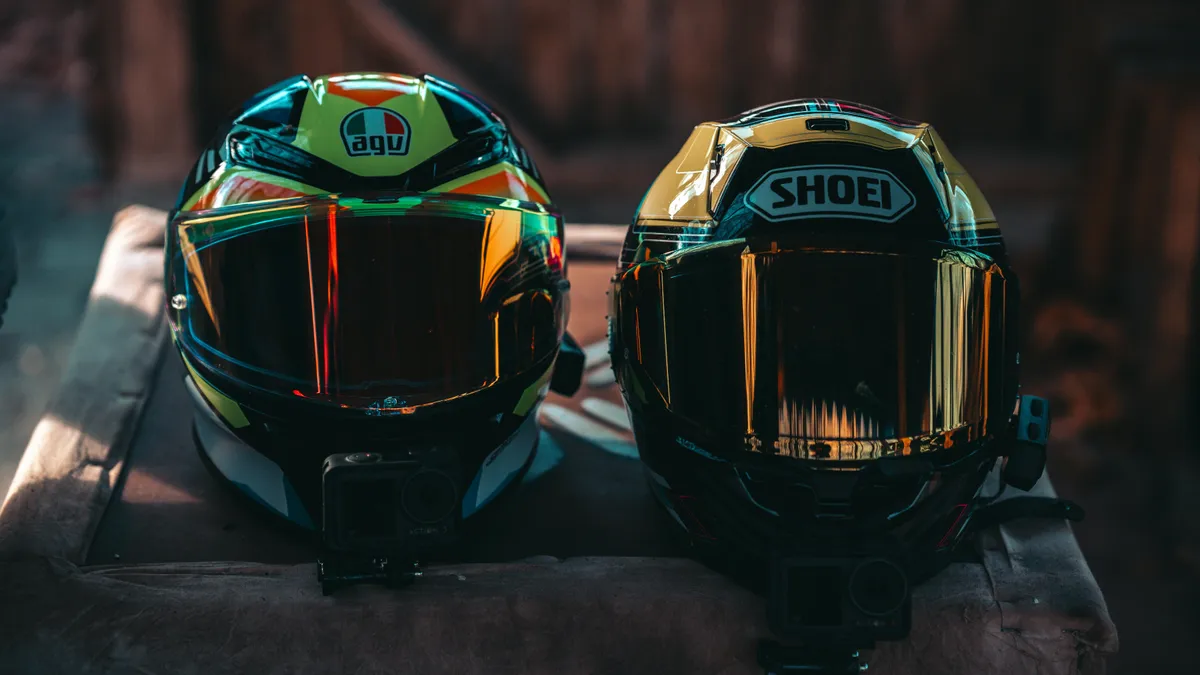
Best Motorcycle Helmets UK 2026
The best motorcycle helmets for UK riders, compared by official SHARP star rating - from 5-star picks to value options, all ECE 22.06 approved, with fit and price weighed up.

Obsessive researcher who reads every Reddit thread and expert review so you don't have to. Years of research behind every guide.
Looking for more gear recommendations?
Browse All GuidesYour helmet is the only thing standing between your skull and the tarmac, and no other piece of kit comes close to mattering as much. Get this one right and everything else is detail. For most UK riders building or upgrading a kit in 2026, the smartest single pick is the AGV K6 S: a carbon-aramid full-face that is genuinely light on your neck, certified to the current ECE 22.06 standard, and refined enough to live with on a long motorway slog. A helmet is the most personal thing you will buy, though, because the right one depends on your head shape, your riding, and your budget far more than on any badge. Let me lay out the real options, starting with what actually keeps your head intact.
I earn a small commission if you buy through links on this page, at no extra cost to you. As an Amazon Associate, we earn from qualifying purchases. I only point riders toward gear I would be happy to wear myself.
In a Rush? Get the AGV K6 S if budget allows, because it pairs a light carbon-aramid shell with current ECE 22.06 certification and the comfort to wear it all day. If you want proven safety for sensible money, the HJC i70 earns a strong 4-star SHARP rating without the premium spend. And if you tour or commute in all weathers and want the convenience of a flip-up, the Schuberth C5 is the modular to beat. Whatever you choose, make sure it carries ECE 22.06, check its SHARP score, and never sacrifice fit for a badge.
| Best For | Product | Why This One |
|---|---|---|
| Overall | AGV K6 S | Light carbon-aramid shell, ECE 22.06, refined enough for daily miles |
| Best Value | HJC i70 | A strong SHARP rating and ECE certification for sensible money |
| Best Modular | Schuberth C5 | Quiet, premium touring flip-up with all-day comfort |
The Five Helmets at a Glance
Every helmet here carries ECE certification for UK road use, so confirm the ECE 22.06 label inside the strap. The SHARP column is each model's official SHARP star rating out of five at the time of writing, linked to its published test result, since ratings are model and size specific.
| Helmet | Type | Shell | SHARP Rating | Price Band |
|---|---|---|---|---|
| AGV K6 S | Full-face | Carbon-aramid | 5 stars | Premium |
| Shoei NXR2 | Sport full-face | Multi-fibre composite | 5 stars | Premium |
| HJC i70 | Full-face | Polycarbonate | 4 stars | Value |
| Schuberth C5 | Modular | Composite | 4 stars | Premium |
| HJC RPHA 11 | Sport full-face | Composite | 3 stars | Mid |
How I Picked These: Years in the saddle teach you that a helmet is the one purchase where the marketing and the reality diverge most, so I lean on the things that can be checked rather than the things a brochure claims. That means the SHARP star ratings from the UK government's own crash-testing scheme, the current ECE 22.06 certification status, owner reports on fit and noise over real seasons, and the consensus across rider communities. I have not crash-tested any of these on a rig, and you should be sceptical of any roundup that says it did for a list like this. What I weigh is whether the protection is properly certified and independently rated, whether the helmet is quiet and comfortable enough to wear for hours, and whether the fit suits a recognisable head shape. A helmet that hurts after twenty minutes is one you will quietly stop wearing on short trips, and that is when the worst happens.
Understanding ECE 22.06 and SHARP Ratings
Two things govern helmet safety in the UK, and they do different jobs. The first is the legal standard. Every new helmet sold here must meet ECE 22.06, the European standard that replaced ECE 22.05 and became mandatory for new approvals from mid-2023. The newer standard matters because it tests more than its predecessor did: alongside the familiar straight-line impacts, it adds oblique impact testing that measures the rotational forces now understood to drive a lot of brain injury, and it tests the helmet at more points and more speeds. Older 22.05 helmets remain legal to wear, but when you are buying new there is no reason to choose the older standard over the newer one. Look for the 22.06 approval label inside the strap.
The second thing is independent rating, and that is where SHARP comes in. SHARP is the UK government's Safety Helmet Assessment and Rating Programme, run independently of the manufacturers. It buys helmets off the shelf, crash-tests them across a range of impact speeds and locations, and publishes a one-to-five-star rating. The crucial point is that ECE certification is a pass-or-fail floor, while SHARP tells you how far above that floor a given helmet actually performs. Two helmets can both be ECE 22.06 certified and still earn very different SHARP scores. Before you commit to any lid, search its exact model on the SHARP database and see how it rated. For context, riders coming from the United States will know DOT and Snell, but those schemes are not the UK reference point. Here, ECE 22.06 is the legal standard and SHARP is the rating to trust.
Shell Sizes, Weight, and Why They Matter
There is a detail most helmet listings gloss over that quietly affects both fit and safety: the number of shell sizes a model is built in. A cheaper helmet often uses one or two shells across the whole range, padding out the smaller head sizes with thicker internal foam. The result is that a small head ends up wearing a shell sized for a much bigger one, which feels and looks bulky and adds weight where you least want it. Premium helmets like the AGV K6 S and the Shoei NXR2 use several shell sizes, so a small fits a small shell and a large fits a large one, keeping the proportions and the weight sensible across the range. This is part of what you pay for at the upper end, and it is worth knowing if you have a smaller head, because the difference in how a multi-shell helmet sits is noticeable from the first ride.
Weight matters more than new riders expect, and it compounds over distance. A helmet that feels fine for the first ten minutes on the showroom floor can leave your neck and shoulders aching after an hour on the motorway, and a tired neck is a distracted rider. The carbon-aramid shell of the K6 S is the clearest example of weight saved going straight into comfort, but even among similarly priced lids a few hundred grams makes a real difference on a long day. It is also a genuine safety point, since lower helmet mass means less rotational load on your head and neck in a crash. If you ride distance, treat weight as a spec worth paying attention to rather than a footnote.
The Best Overall: AGV K6 S The AGV K6 S is the helmet I point most riders toward when budget is not the binding constraint, because it gets the things that matter day to day right. The shell is a carbon and aramid fibre blend, which keeps the overall weight low, and a light helmet is one you notice less at the end of a long ride and one that puts less strain on your neck in a crash. It is certified to the current ECE 22.06 standard, the eye port is usefully wide, and the ventilation actually moves air rather than just looking the part.
Who it is for: the everyday rider, commuter, and weekend tourer who wants a light, refined, properly certified full-face and is willing to step up for it. The detail you only appreciate after a few hundred miles is how much the low weight reduces fatigue, since a heavy helmet quietly tires your neck and shoulders on a motorway run. The honest limitation: it sits at the premium end, AGV shells tend to suit a more intermediate-to-long oval head shape, and the comfort liner is firmer than some rivals out of the box. Try one on before you commit, and confirm its current rating on the SHARP database. For a do-everything full-face you will reach for without thinking, this is the one.
AGV K6 S
AGV
A carbon-aramid shell that weighs around 3.3 lb yet carries DOT and ECE 22.06 certification. Race-bred aerodynamics, huge eyeport,...
Check Price on Amazon →The Premium Sport Pick: Shoei NXR2 If your riding leans sporty and you want a benchmark full-face with a serious safety pedigree, the Shoei NXR2 is the obvious choice. It is certified to ECE 22.06 and has been one of the standout performers in SHARP testing, which is exactly the combination you want: a current legal standard plus a strong independent rating. Shoei build quality is the part owners talk about most, from the precise visor seal that keeps the rain out to the emergency cheek pad release that lets first responders remove the helmet safely.
Who it is for: sport and fast road riders, and anyone who simply wants a top-tier full-face and rates safety performance above all. The detail worth knowing is that the NXR2's aerodynamics are tuned for a head-down riding position, so it feels most settled when you are tucked in behind a screen at speed. The honest limitation: it is a premium-priced helmet, the fit favours a rounder-to-intermediate head shape than the AGV, and the focused sport ergonomics make it slightly less relaxed upright in town than a touring lid. Check the exact NXR2 variant on the SHARP database before buying, since ratings are model-specific. For a rider who wants proven protection in a sport package, it is hard to fault.
Shoei NXR2
Shoei
The sweet spot for serious riders. 5-star SHARP rating with premium comfort and ventilation. Long oval fit suits most head shapes....
Check Price on Amazon UK →The Sport Mid Pick: HJC RPHA 11 You do not have to spend Shoei money to get a genuinely capable sport helmet, and the HJC RPHA 11 is the proof. It is HJC's lightweight sport flagship, built on a multi-layer composite shell that keeps the weight down, with a wide visor aperture and a quick-change mechanism that makes swapping to a tinted visor painless. For a rider who wants the aggressive ergonomics and light feel of a sport lid without crossing into premium territory, it lands in a useful middle ground.
Who it is for: the spirited road rider and trackday occasional who wants sport-helmet feel and light weight at a mid-range outlay. The detail owners appreciate is the emergency cheek pad release, a feature usually reserved for pricier helmets, and a liner that comes out for washing. The honest limitation: wind noise is higher than a dedicated touring helmet, the ventilation is tuned more for cooling at speed than for slow town riding, and you should confirm the specific RPHA 11 version you are buying against the SHARP database, since HJC sells several similarly named models. As a sport helmet that does not demand a premium budget, it earns its place.
HJC RPHA 11
HJC
A lightweight PIM-shell sport full-face with ECE certification, a wide eyeport, and quick-change shield. A popular do-it-all sport...
Check Price on Amazon UK →The Best Value: HJC i70 The HJC i70 is the helmet I recommend most often to riders who want proven safety without the premium outlay, because it is the clearest evidence that a sensible budget and a strong SHARP rating are not mutually exclusive. It is ECE certified, it carries a built-in drop-down sun visor that saves you carrying a tinted spare, and the build quality holds up far better than the price suggests. For commuters and new riders especially, it removes the false choice between affordability and a well-rated lid.
Who it is for: the commuter, the new rider on a sensible budget, and anyone who would rather put the saving toward gloves, boots, or a back protector. The detail worth knowing is that the internal sun visor is genuinely useful in the UK's low winter sun, where glare off a wet road is a real hazard. The honest limitation: it is heavier than the carbon-shelled AGV, it is noisier on the motorway, and the interior materials feel less plush than a premium helmet. None of that affects how it performs in a crash, which is the whole point. Confirm the current rating for your exact size and model on the SHARP database, then buy with confidence. For most riders most of the time, this is the value benchmark.
HJC i70
HJC
Budget helmet with premium safety. 5-star SHARP rating at under £200. Internal sun visor, decent ventilation, and ECE 22.06 certif...
Check Price on Amazon →The Best Modular: Schuberth C5 If you tour, commute through filtering traffic, or simply hate taking your helmet fully off at every fuel stop, a modular flip-up earns its keep, and the Schuberth C5 is the premium standard. Schuberth built its reputation on quietness, and the C5 carries that forward with aero shaping and sealing that keep wind noise unusually low for a flip-up. It is ECE 22.06 certified in both the closed and open positions, has a drop-down sun visor, and is ready for an integrated communication system that tucks neatly into the shell. If you are ready to add comms, the best motorcycle intercom UK guide covers the units worth pairing with it.
Who it is for: tourers, long-distance commuters, and riders who wear glasses or value the convenience of flipping the chin bar up at a junction or petrol station. The detail owners value most is the low noise, which makes a real difference to fatigue over a full day in the saddle. The honest limitation: a modular helmet is heavier and more complex than a one-piece full-face thanks to the hinge mechanism, it sits at the premium end, and a flip-up will never be quite as structurally simple as a fixed chin bar. Always ride with the chin bar latched down, not open. Check the C5 on the SHARP database for its current rating. For touring convenience without a noise penalty, it is the modular I would choose.
Schuberth C5
Schuberth
Premium modular helmet for touring riders. P/J certified safe with chin bar up or down. Exceptional noise reduction and comfort fo...
Check Price on Amazon →Visors, Pinlock, and Fogging in the UK
Whichever helmet you choose, the part you will interact with most is the visor, and in British conditions that means thinking about fog before anything else. A cold, damp morning and warm breath behind a sealed visor produce condensation in seconds, and a fogged visor at a junction is genuinely dangerous. The fix is a Pinlock insert, a second clear lens that fits inside the main visor on small pins and creates a sealed air gap that resists fogging much the way double glazing does. Most quality helmets, including all five here, are Pinlock-ready, and on a UK helmet I would treat fitting an insert as close to essential rather than an extra. Check whether one is included in the box, because some helmets bundle it and some sell it separately.
A drop-down internal sun visor, fitted to the i70 and the Schuberth C5, is the other feature that pays off here. The UK's low winter sun sits right in your eye line on a clear afternoon, and glare off a wet road compounds it. A flick-down tinted visor solves that without you having to carry and swap a separate dark visor, and it retracts in an instant when you ride into shade or a tunnel. Ventilation is the third visor-adjacent consideration: good vents clear the inside of the visor as well as cooling your head, and a helmet whose vents you can work easily with gloves on is one you will actually use. None of these features change a helmet's crash performance, but they are the difference between a lid you tolerate and one you genuinely enjoy wearing through a British year.
Not sure whether you want a sport full-face, a value commuter lid, or a touring modular? The rider type quiz sorts it out in about a minute based on how, where, and when you actually ride.
What to Avoid
Avoid any helmet that does not carry a clear ECE 22.06 approval label inside the strap, and treat novelty or fashion lids with painted-on markings as decoration rather than protection. If a listing talks about styling and a low price but never names a recognised standard, assume it has not been tested to one. The legal floor in the UK is ECE certification, and a helmet that cannot prove it has no place on your head.
Be wary of buying purely on badge or looks without checking the SHARP database. A premium price tag does not guarantee a top rating, and a sensibly priced helmet can outperform a more expensive one in independent testing. The whole reason SHARP exists is to let you see past the marketing, so use it. Search the exact model and size you intend to buy, because ratings can differ between shell sizes within the same range.
Never buy a second-hand helmet. A lid that has taken an impact can be compromised in ways you cannot see from the outside, the protective liner degrades with age and with the oils and sweat of its previous owner, and you have no way of knowing whether it has been dropped onto a hard floor. Helmets also have a usable life and should be replaced after a significant impact or after several years of regular use. Buy new, from a reputable retailer, every time.
Finally, do not chase the lightest or the flashiest helmet at the expense of fit. A helmet that is the wrong shape for your head, no matter how exotic the shell material or how high the rating, will not protect you the way it should, because protection depends on the helmet staying put and spreading load evenly. Fit first, badge second.
How to Choose: What Actually Matters
Get the fit right, because it beats price and badge every time. A well-fitting sensibly priced helmet protects you better than a loose premium one. Heads come in broad shapes, usually described as round, intermediate oval, and long oval, and brands favour different ones. Shoei and AGV tend to suit longer oval heads, while some HJC and rounder-shell helmets suit rounder heads. Measure the circumference of your head with a tape just above the eyebrows and ears, check it against the maker's own chart, then try the helmet on if you possibly can. It should be snug all the way round with no pressure points, the cheek pads should hug your cheeks firmly, and when you grip the helmet and try to rotate it, your skin should move with it rather than the helmet sliding over your scalp. A helmet loosens slightly as the liner beds in, so a new one should feel firm rather than roomy.
Buy ECE 22.06 and check the SHARP score. ECE 22.06 is the current legal standard and the floor you should not drop below when buying new, because its oblique-impact testing reflects the rotational forces that matter most. Then go to the SHARP database and look up the exact model. The star rating tells you how the helmet performed above the legal minimum across a spread of impact speeds and locations. Treat ECE as the entry ticket and SHARP as the league table.
Pick the helmet type that matches your riding. A full-face like the AGV K6 S or Shoei NXR2 gives the most complete coverage and the best aerodynamics, which is why it is the default for most riders. A modular like the Schuberth C5 trades a little simplicity for the convenience of a flip-up chin bar, ideal for touring and commuting. Sport-focused lids like the HJC RPHA 11 are tuned for a head-down position and feel busier upright in town. Match the helmet to the riding you actually do most weeks, not the riding you imagine.
Weigh up weight and noise honestly. A lighter helmet, like the carbon-aramid AGV, reduces neck fatigue over distance, and a quieter helmet, like the Schuberth, reduces the tiredness that wind roar causes on a long ride. Both matter more the further you ride. For short urban hops they matter less, which is part of why the value-priced i70 makes so much sense for commuters. Be realistic about your typical mileage and let that guide how much you pay for refinement.
Use the safety features that the UK climate rewards. A built-in drop-down sun visor, as on the i70 and the C5, is genuinely useful against the low, dazzling winter sun and saves swapping visors. A Pinlock-ready visor with an anti-fog insert is close to essential for British conditions, since a fogged visor on a cold wet morning is a real hazard. And an emergency cheek pad release, common on the premium helmets here, lets first responders remove your helmet more safely after a crash.
A note on safety: This guide is informational. I am not a certified safety professional. Helmet standards and product specifications change over time, and SHARP ratings are model and size specific, so always confirm the current ECE 22.06 certification on the helmet itself and check the model on the SHARP database before you buy. No helmet eliminates risk; riding always carries it.
Your helmet protects the part of you that makes you you, but it works as part of a complete kit. Whichever lid you land on, pair it with a CE-armoured jacket from the best motorcycle jacket guide, real protection for your hands from the best motorcycle gloves guide, and certified footwear from the best motorcycle boots guide. If you are kitting out for the first time, the beginner motorcycle gear guide walks you through the lot in the right order, and if budget is the main constraint, the budget motorcycle helmets guide covers the well-rated lids worth your money. Still unsure which suits you? The rider type quiz will point you the right way.
What I'd Buy Today
If I were buying one helmet this week and the budget allowed, I would get the AGV K6 S. It is light, it is certified to ECE 22.06, and it is refined enough that I would happily wear it for a full day in the saddle, which is the real test of a helmet you will reach for every ride. If I wanted proven safety without the premium spend, I would buy the HJC i70, check its SHARP score for my size, and put the saving toward gloves or a back protector. And if I toured or commuted long distances and wanted the convenience of a flip-up, I would step up to the Schuberth C5 for its quietness and all-day comfort. Once the helmet is sorted, a motorcycle intercom is the upgrade that changes what every ride with other people feels like.
Whatever you choose, fit it properly, confirm the ECE 22.06 label and the SHARP rating, and go put some miles on. The best helmet is the one that fits your head, suits your riding, and that you put on without a second thought every single time you swing a leg over.
Frequently Asked Questions
Related Guides
Find Your Perfect Gear
Expert guides for helmets, jackets, gloves, boots, and more. Safety-focused recommendations for UK and US riders.
Browse All Guides